Introduction
Over the years, I have been a big fan of productivity tools. Back in the day, I would drool over the variety of dayrunner folders and their page inserts. Later, it was productivity software. After that, systems and frameworks and gimmicks and whatnot. I kind of stopped when I hit the “Hipster PDA.” Admittedly, I did not immediately stop there. I played with all the templates, especially the D*I*Y Planner templates. There is so much potential, so much hope, in those templates. I fell in love with the idea of those templates, but discovered most of them were just not as useful or flexible as a blank index card. As cool as they are, I had to give up most of those templates.
I discovered that, for me, there are two main types of Hipster PDA index cards that are useful. Your mileage may vary, but for me, there are two:
- The blank card. Okay, technically, I prefer the graph paper index cards from Levenger because I’m a nerdy engineer, but most people would consider these “blank.”
- The pre-printed reference card. There are times when I want to have something on-hand to look up at a moment’s notice. And I really do mean a moment’s notice — not take out the iPhone, turn it on, enter the lock code, launch Evernote, search for the note I’m looking for, then open it.
The blank card is just that. There is no system or template that can help there. The pre-printed reference card is mainly customized to me and my life, but might be useful to others — or at the very least, may serve as inspiration. For instance, I have one for work as a reference for things like model numbers and programming constants that is of little interest outside the workplace. I have a pre-printed shopping list where I can just tick off the things I need; the items are specific to me and my life but others may find them useful. The style, with different items, could work for others.
My Hipster PDA Index Card Templates
Click through to a given card’s page to see more detail, view a sample, and download a PDF. I designed most, if not all, of the templates for printing double-sided on 8-1/2″ x 11″ cardstock. The layout and alignment then lets you cut them apart into four double-sided cards per page.
Sudoku
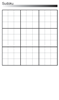 The blank Sudoku grid was one of my first templates. It has gone through several revisions, both with and without light “guess numbers” in each square.
Shopping List
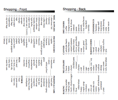 The shopping list has gone through several revisions. I always have one clipped to the fridge and can load it into the Hipster PDA when it is time to go to the market. Although I expect you may not find them useful as-is, it should serve as an inspiration for your own list.
ARG/Programming Tools
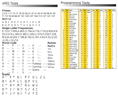 The ARG and Programming Tools templates are read-only reference for common data used in programming and ARG puzzle solving. This includes an ASCII table, decimal-to-hex conversion and vice-versa, several coding schemes (Morse code, braille, ROT13), a list of primes, and a list of English letter frequencies.
Scrabble Cheat Sheet
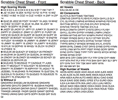 The Scrabble Cheat Sheet is a reference of high-scoring and unique words in Scrabble. This includes Q-without-U, words with large numbers of consonants, and large numbers of vowels.
Portland Map
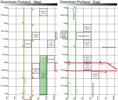 This is the first revision of a not-quite-to-scale downtown Portland map with the bus routes and stops that I am primarily interested in. It served well over Christmas, in that I could mark down the locations of stores I rarely frequent. I know the locations I typically go to and their proximity to bus stops, but needed a good memory-jog for those rarely-visited locations.
Exercise Cards
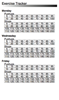 This is a set of four exercise tracker cards for use in the hundred-situps and two-hundred push-ups program. You can mark off your progress as you complete each set, so as not to lose count.
Title Page
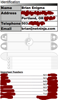 The Title Page is a quick reference of my contact information as well as a phone list for important numbers. It serves three purposes. First, I never remember my own phone number, so it’s nice to have it available at a glance. Second, if my phone (where I keep all of my phone numbers) breaks and I need to call someone for help from another phone, I have important numbers. Third, if I’m found unconscious in a ditch, the authorities can see who to call.
Hanging Envelopes
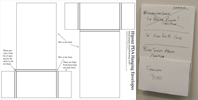 These are technically not Hipster PDA cards, but a template for a “hanging folder” that you can stick to a wall or other surface. I use a couple at work for quick access to a few cards.